Robert's Ramblings is my place to show my passion for this amazing world.
Images, words and insights are my way of sharing that passion.
Welcome to my blog.
Thursday, October 16. 2008
Innovation Mentor - Making Wikis Work - Part 1
 A truly powerful wiki comes from enthusiastic participation of all the users in a wiki community. The diverse nature of that community, however, means that participation by all almost never happens! ...
 ... to read more please visit my complete article making wiki's work - part 1 at innovation mentor.
Until the next post, take care out there and keep wikiing ( if that's what you do! ) ...Robert

Monday, October 13. 2008
Beautiful Edithburgh, It's Getting Warmer
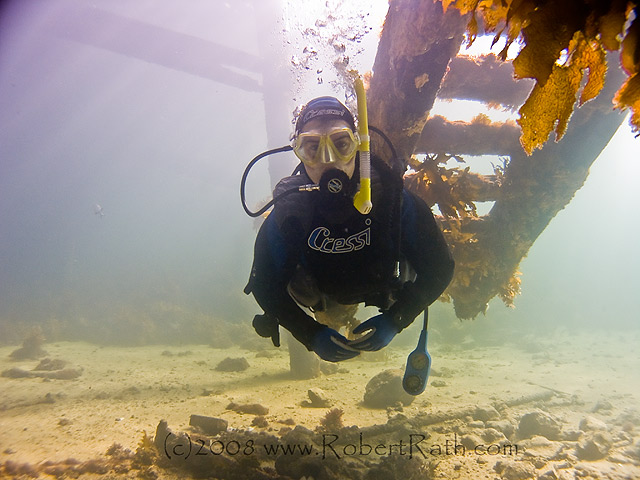
The last 6 weeks has seen a dramatic change to the water temperature over in Edithburgh. I mean really dramatic! Six weeks ago I recorded 12C degrees and this weekend we recorded 18C. That's 1C per week. Winter is officially over!
Sadly I was not able to take any photographs this trip as I had a very large class of new divers who I will add are all now certified open water divers. Congratulations to Belinda, Sandi, Peter, Jenni, Claire, Harry, Cherrie, Scott, Kerry and Dave. Welcome to a whole new world of scuba diving! Thanks also to Brent for racing around keeping everyone under control and to Jennifer for being the wonderful host she always is and for posing for this photo taken back in May.
Until the next post, take care out there and keep diving ( if that's what you do! ) ...Robert
Photo: Robert Rath C5060 1/180s at f/2.8 ISO100 Inon UWL100-28AD Lens
Friday, October 10. 2008
Ideas are Abundant, Don't Ignore Them
Thursday, October 9. 2008
Jennifer's Wordsworx Blog
Well done Jennifer on bringing http://www.wordsworx.com back to life!
No longer just another web based flyer. The site has been transformed into a blog centric podium for Jen to woo with her wordly wisdom ( www)
Check out her first words here! 'mark my words'
No longer just another web based flyer. The site has been transformed into a blog centric podium for Jen to woo with her wordly wisdom ( www
)Check out her first words here! 'mark my words'
Trust Us, We're MICROSOFT!
Three Guesses? - Edithburgh Jetty, South Australia
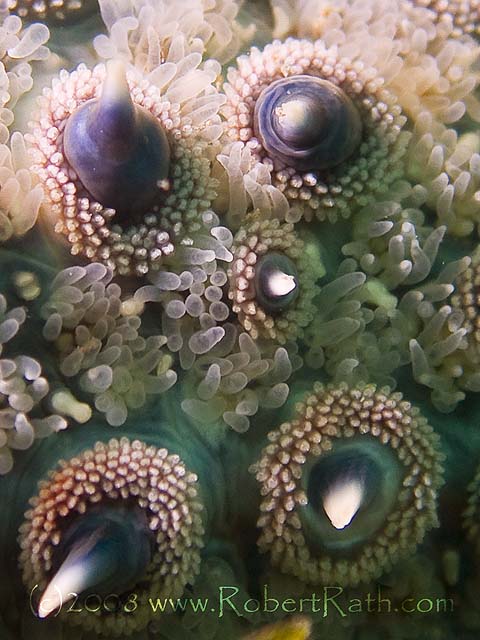
This stunning image is something nearly every South Australian diver has seen, especially in and around our local jetties. Have you guessed yet what it is? Meet Coscinasterias muricata.
The Eleven-armed Sea Star is the largest sea star you will find in South Australian coastal waters and is very common. The next time you come across one, take a close look and you will find the upper surface of this sea star is covered in small spines. These spines are called pedicellariae and they can be manipulated like tiny claws to either catch food or ward off predators.
Pretty scary from this vantage point!
Until the next post, take care out there and keep diving ( if that's what you do! ) ...Robert
Photo: Robert Rath C5060 1/60s at f/8 ISO100, Lens Inon UCL165AD Macro Lens, Inon D2000 Strobe
Monday, September 22. 2008
Who Are You Really?
 Think very, very carefully before you sign up to Facebook, to MySpace or to LinkedIn. Oops ... too late is it?
I recently wrote a short article on your 'digital footprint'. That trail of information you create out there on the internet that tells anybody who cares to look, all about you. Or, does it?
Intrigued? You should be! Read my full article at http://www.innovation-mentor.com
Until the next post, take care out there and keep diving ( if that's what you do! ) ...Robert
Tuesday, September 16. 2008
Spring Is Here, Need To Take More Photos!
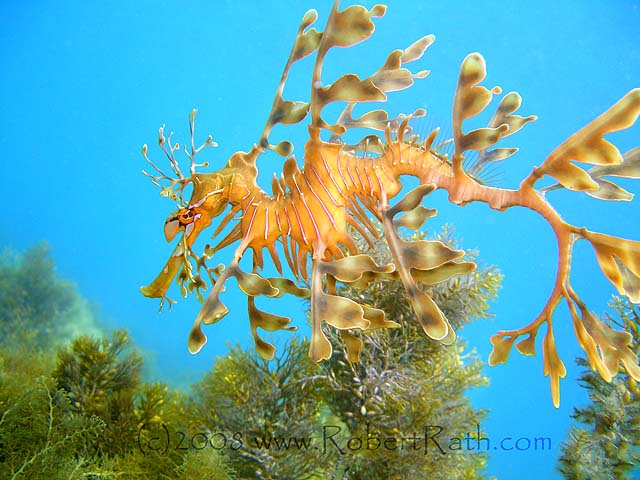
Well spring may be here but the water is still as chilly as ever. Give it a month and we will start to see it begin to warm up.
Going through some old photos and found one I'd never published before. I can't tell you much about this photo other than I took it with one of my student's cameras on a recent Advanced Open Water course. I think it was a Canon Exelim (thanks Kirstin) but that's all I have to go on. This gorgeous leafy Seadragon posed beautifully with just enough grass and algae for interest and just enough blue water for the dramatic.
You do not need to spend a lot on an underwater camera to get some stunning photos. This photo, taken with a point-and-shoot camera, demonstrates that being close, composing well (this photo is un-cropped) and taking plenty of photos will result in photos any new underwater photographer can be proud of.
Until the next post, take care out there and keep diving ( if that's what you do! ) ...Robert
Friday, September 5. 2008
Not Another Website! Innovation Mentor
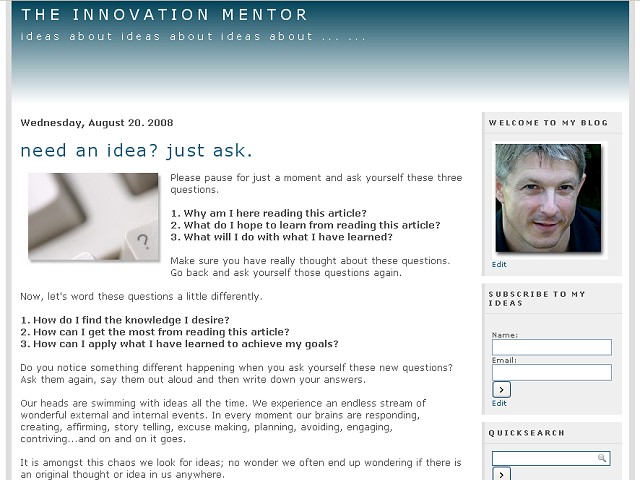
Sorry disappoint any of you waiting for my next great shot. I have been busy working on my latest project, a new website for www.innovation-mentor.com.
Ok, yes this is work so it will not be everyone's favourite hangout. You might however find some interesting thoughts and ideas there so maybe visit at least once or twice.
I have created Innovation Mentor as a place to start a regular series of articles about creativity and innovation. It will be mostly business focussed but will also explore innovation in other aspects of our lives.
The site is 'Blog" based which means you can all participate so please feel free to make comments, suggestions or just say hello! If all you want are more great underwater photos, you will not have to wait to long for the next installment!
Until the next post, take care out there and keep being creative, innovative, oh and also diving ( if that's what you do! ) ...Robert
Wednesday, August 27. 2008
Speak To The Hand
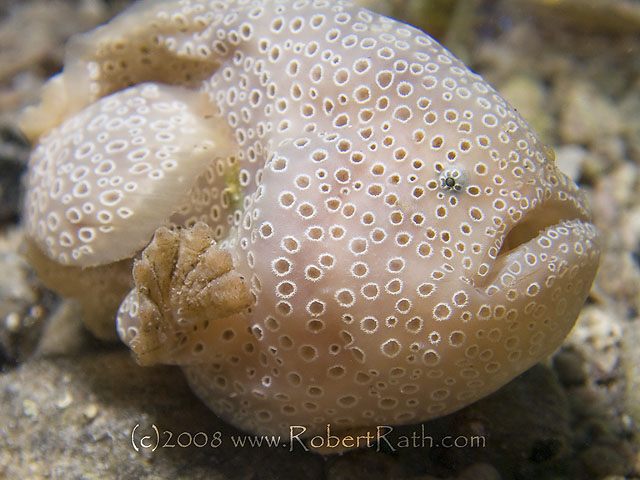
Last weekend I was teaching again over in Edithburgh and as usual the camera comes along for that 'after the course' photography dive. Despite the chilly 12 degrees, this little guy just made my weekend! Oh, and the Title 'Speak To The Hand' ... need I say more!
I have not yet been able to identify this species of Anglerfish, or Frogfish but I suspect it may be a Cryptic Anglerfish Histiophryne cryptacanthus. I will post back with more info when I have learned more. For some great information on Anglerfish in South Australia please read Janine Baker's on-line reference at http://www.reefwatch.asn.au/pages/bin/view/Publications/SamsccANTENNARIIDAE
Yes the water is cold but I have to say diving in a drysuit makes an enormous difference. A good semi-dry wetsuit is still quite usable at 12 degrees but usually leaves you so chilled that one dive is all you are up for. This is our second year of teaching open water divers in drysuits. Even after 3 teaching dives I could not wait to get back in the water again for some fun with the camera.
So if you are keen to keep diving all year round here in South Australia, the investment in a drysuit may be just what's needed to keep you in the water!
Until the next post, take care out there and keep diving ( if that's what you do! ) ...Robert
Photo: Robert Rath C7070 1/60s at f/4.5 ISO80 Inon UCL165AD Macro Lens and D2000 Strobe
Tuesday, June 3. 2008
WetShutter Gallery - Beta Preview (www.wetshutter.com)
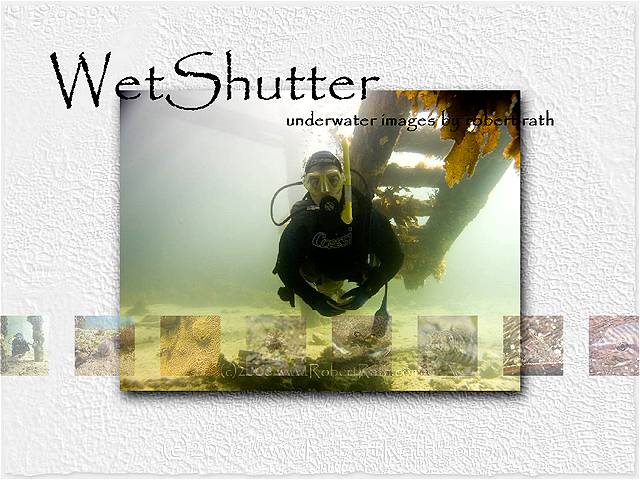
I'm delighted to report that many people have expressed interest in seeing more of my underwater images. At last I have been able to spend some time getting my new image gallery up and running.
Introducing www.wetshutter.com
This new site is a 'Beta' standard preview. It is a 'first look' for comments and suggestions. It is also my first attempt at flash programming, so please don't be too harsh!
For testing I've uploaded only a small number of images from a recent trip to Edithburgh. Of course I will add many more when I'm happy that the site is operating without any technical issues.
Please feel free to make comments, suggestions or just say hello!
Until the next post, take care out there and keep diving ( if that's what you do! ) ...Robert
Monday, April 28. 2008
Blue Ringed Octopus - Edithburgh Jetty

The Blue Ringed Octopus, Hapalochlaena maculosa, is one of the deadliest creatures in the sea! Its powerful venom can easily kill a human despite its diminutive size of less than 12cm.
Although these creatures are a relatively common inhabitant here at Edithburgh, they're not often seen as they hide during the day and come out at night to hunt. This guy seemed only slightly annoyed as the bright strobe captured this image before crawling away at a leisurely pace to hide under a nearby rock.
The weekend was great with the water temperature still at 19 even though the days were a chilly 15! A good friend Paul joined us for one of the days and he made quite a find too..., but I'll leave that for another post!

Due to repeated requests I have upped the resolution of my photos but am using more compression to keep the size down. Please let me know what you think.
Until the next post, take care out there and keep diving ( if that's what you do! ) ...Robert
Photo: Robert Rath C5060 1/60s at f/4.0 ISO100 Inon UCL165AD Macro Lens and D2000 Strobe
Monday, March 31. 2008
Swimming Pool, Edithburgh Australia
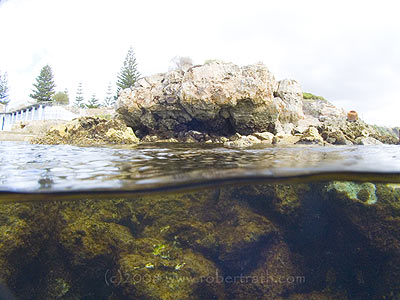 Edithburgh is famous as a jetty dive of unsurpassed diversity and beauty. However, all of Edithburgh's coast is just as beautiful and often overlooked. The 'Swimming Pool' is one such area.
Edithburgh's 'Swimming Pool' is a tide filled seawater pool offering a safe place for families to enjoy a lazy afternoon by the sea just a few meters short of the unknown. But slip out of the pool and into the ocean you find yourself in a snorkeller's paradise.
Dusky Morwongs, Old Wives, Leatherjackets, Cuttlefish, Stingrays, Sweep, Moonlighters, Whiting, Mulloway, Magpie Perch, Zebra Fish, Talmas, Blennys, Starfish, Urchines, Abalone, Scallops, Blue Grouper and Wrasse dance among the rocks and kelp in less than 2m of water. Many of the species seen will be juveniles as this rocky coastal area is a nursery for many of the bigger off-shore reef fish.
So next time you find yourself at Edithburgh with a potential future diver take them for a snorkel in the Swimming Pool.
Until the next post, take care out there and keep diving ( if that's what you do! ) ...Robert
Photo: Robert Rath C5060 1/125s at f/6.7 ISO100 Inon UWL100-28AD Lens
Thursday, February 14. 2008
Seahorse
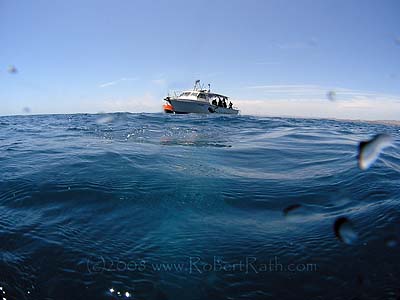 Seahorse is the boat I seem to spend most of my time on, shore dives come second, and somewhere down the list I actually get to dive from my own boat every now and then.
This photo was taken just before descending onto the Hobart a couple of weeks ago. The conditons were so good you could snorkel over to any part of the ship for a free descent. Usually, strong currents limit access to and from the ship on lines, so this day was a rare treat.
Until the next post, take care out there and keep diving ( if that's what you do! ) ...Robert
Photo: Robert Rath
Monday, January 21. 2008
AV Ulonga - Big Boys Dive
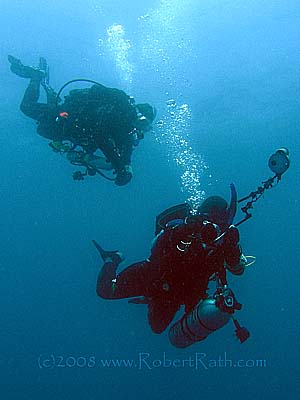 Last week a lucky few of us had the chance to dive the AV Ulonga.
The AV Ulonga was a Murray River paddle steamer converted to be an ocean-going cargo vessel. She sank in 1976 in around 38m of water about 10 nautical miles off the coast of South Australian's Fleurieu Peninsula. At over 33m in length with some penetration, she makes for a fantastic dive.
Pictured above on the descent are Alexius, with camera at the ready, and Ken. Notice the extra tanks we all took down for the dive. I'll let you guess what's in them!
For more information on the history of the AV Ulonga checkout Steve Reynold's article at http://www.mlssa.asn.au/nletters/march2005.htm
Until the next post, take care out there and keep diving ( if that's what you do! ) ...Robert
Photo: Robert Rath C5060 1/500s at f/4 ISO200 Inon UWL100-28AD Lens
Saturday, January 19. 2008
Ex HMAS Hobart
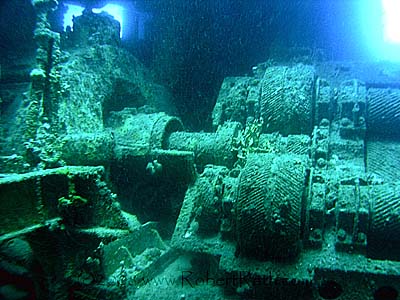 The Ex-HMAS Hobart is one of Australia's best naval wreck dives. This Adam's class guided missile destroyer was sunk here in 2002 as an eco-tourism draw card.
At over 130m long there's a lot of wreck to dive on. Much of the wreck is in the 15-25m region which gives lots of bottom time. Still plan at least 10 dives to see it properly!
This photograph was taken in one of the engine rooms at around 23m.
As my first 'fun' dive for the year and my first dive on the Hobart with my camera, it was a fantastic way to kick-start 2008.
Until the next post, take care out there and keep diving ( if that's what you do! ) ...Robert
Photo: Robert Rath C5060 1/30s at f/6.7 ISO200 Inon UWL100-28AD Lens
Tuesday, December 4. 2007
88 Keys... But Who's Counting?
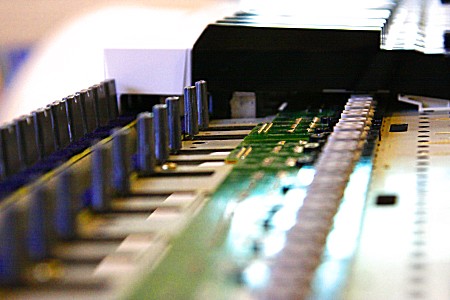 We recently acquired a pre-loved Roland HP1500 digital piano at a real bargain price.
 The real price in time and effort, however, proved to be another matter altogether. This piano was plagued with sticky keys. The previous owner claimed that two keys 'could be temperamental'. Once home, I could easily get eight keys to stay down permanently.
An hour later we had the piano entirely in pieces, with every single key mechanism removed.
Yes, all 88 of them.
Another hour later everything was cleaned and re-greased ('O'-ring grease worked a treat here) and I was ready to re-assemble. This is when the fun began!
Notice the grey PVC guide posts in the photograph. These are meant to be a perfect non-interference fit inside the keys. Too sloppy, and the key wobbles sideways. Too tight, and the key gets stuck. Like Baby Bear's porridge they need to be 'just right'.
As I replaced each key mechanism I tested the clearance. Even though only a few jammed, nearly a third were a little too tight and dragged the key action. Four hours of testing, filing, testing and filing every single guide post saw the job finally done.
Once again the piano felt beautiful to play.
So why did the keys become sticky? The keys may have deformed over time, but I suspect the PVC guide posts are to blame. Over time they may have swelled as a reult of absorbing solvents from the grease.
This is exactly the same reason why we use silicon-based grease for our camera housings. Having re-greased the keys using silicon 'O'-Ring grease, our piano should feel great to play for many years to come.
Until the next post, take care out there and keep making beautiful music ( if that's what you do! ) ...Robert
Update 2008-11-10 Response To a Received Email
I had no access to the service manual so simply undertook the task with screwdriver in hand and enthusiasm. I do remember that removing each and every key mechanism took a bit of knack and practice but I don't remember it being too difficult.
To clean the contacts (see photo ContactMech), I removed the rubber contact mechanism and cleaned both the carbon inserts and PCB contacts using methylated spirits and lint free optical tissues then reassembled.
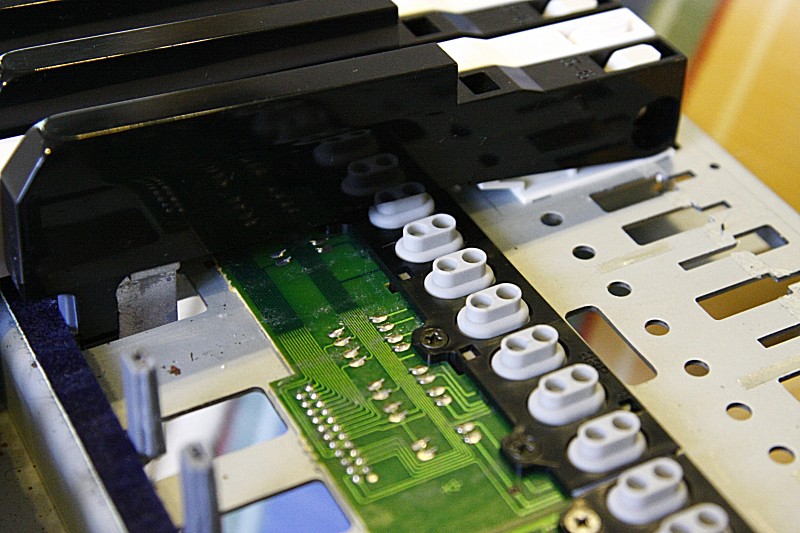
The big job was the PVC guides (se photo PVC_Guides). This required very carefully sanding the outside edges of the guides with fine grade wet and dry emery paper then carefully cleaning with lint free tissues and then checking for fit. By making small changes and regular checking I effectively crept up on the correct fit. I set it to the barest perceptible drag with no slop.
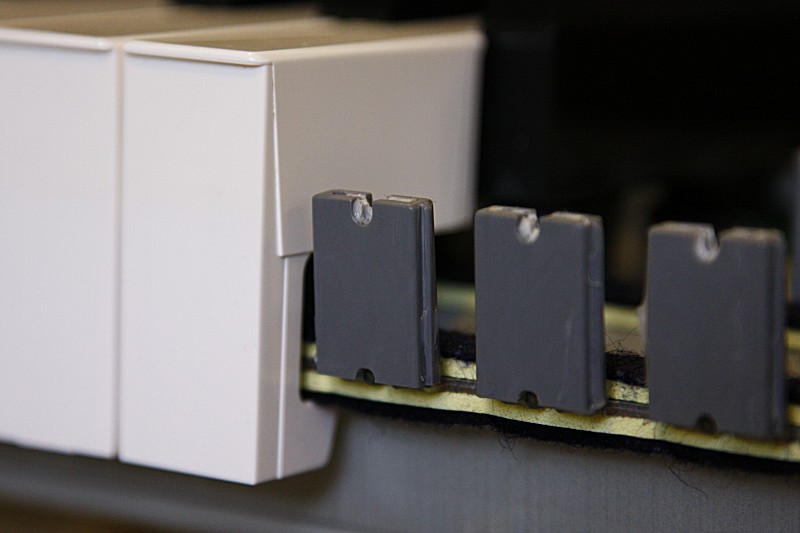
Re-greasing (see a clear looking grease on the edges of the guides in the photo). Re-greasing required removal of all the old grease and the application of a small amount of silicon based grease. I used o-ring grease normally used to lubricate the silicon o-rings using in underwater camera housings. The key is the grease must not be petroleum based to avoid it being absorbed by the PVC and expanding.
... Robert
Update 2013-07-15 Response To a Received Email
I got another email asking about the 'trick; in getting the key mechanisms off the frame.
I actually can't remember now how I did it but looking at the photo of the back of the key where the white plastic base attaches to the pressed metal frame I can see that each key attaches into a round hole near the front and the double rectangular slotted cutout just behind it.
My guess is that I gently levered the front of the white plastic to clear the round pin from the round hole and then when lifted clear the rest of the white plastic base slid either forwards or backwards to be released.
Again, I am only guessing from what I can see in the photo.
Friday, October 26. 2007
Humpback Whales Over Cockle Bay Wharf, Darling Harbour - Sydney
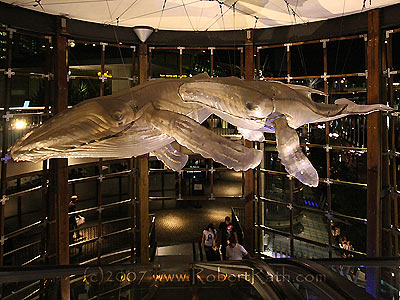 This sculpture of these beautiful creatures, 'Whales x 2' is the work of Terrance Plowright and can be found at Cockle Bay Wharf in Sydney's popular Darling Harbour.
I have been captivated by the humpback whale, Megaptera novaeangliae since seeing the amazing photography of Tony Wu from his recent trip to Tonga. His photography of these incredible creatures during the calving season is simply stunning. Please visit his site and be prepared to be gob-smacked!
Until the next post, take care out there, keep diving ( if that's what you do! ) ...Robert
Photo: Robert Rath EOS40D 10mm 1/40s at f/4.0 ISO3200
Monday, October 15. 2007
Meow Said The Shark, Encounter Bay SA
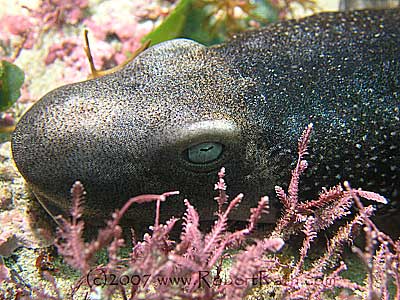 So why did the shark say meow? Because it was a catshark of course! I found this Varied Catshark, Parascyllium variolatum, while diving Whalebone Caves in Encounter Bay a few weeks ago.
Although found in a wide variety of Southern Australian habitats, little is know about this normally nocturnal shark. Fortunately for me this guy was up late. Unfortunately, trying to take the photos through gaps in the kelp made it hard to get a clear shot.
Whalebone Caves is another one of my favourite South Australian shore dives. Not very deep and only a stroll from the car park, this dive is like being in an aquarium. With an intricate maze of tunnels, caves and swim-throughs carved from the limestone sea-bed, this little place is fun to explore or just to hang out in at the end of a day's diving.
Until the next post, take care out there, keep diving ( if that's what you do! ) ...Robert
Photo: Robert Rath C5060 1/60s at f/3.5 ISO100 Lens UCL165AD Macro, Inon D2000 Strobe
Saturday, October 6. 2007
King Scallop - Edithburgh Jetty, SA
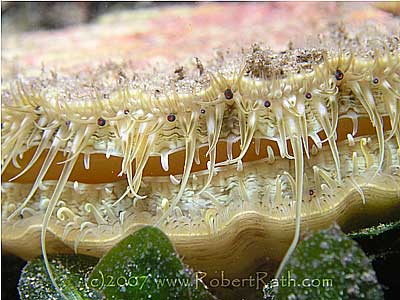 This stunning looking creature is also the prize of many great seafood chefs. The King Scallop, Pecten fumatus is highly prized by the commercial fishery industry in Southern Australia.
Also known as the Southern Scallop, the Tasmanian Scallop or the Commercial Scallop, they can grow to over 14 cm across and live for just as many years. Scallops are filter feeders, living on plankton and other organic debris and are common to all our coastal waters.
This photo was taken on a night dive during my last Open Water course over in Edithburgh. It's fun to leave the students on the jetty, then come back to them with photos of what they'll soon be experiencing for themselves.
Until the next post, take care out there and keep diving ( if that's what you do! ) ...Robert
Photo: Robert Rath C5060 1/30s at f/8 ISO200 30mm, Lens UWL100-28AD, Inon D2000 Strobe
Tuesday, October 2. 2007
Staring Into Heaven - Milky Way At Mambray Ck Flinder's Ranges, SA
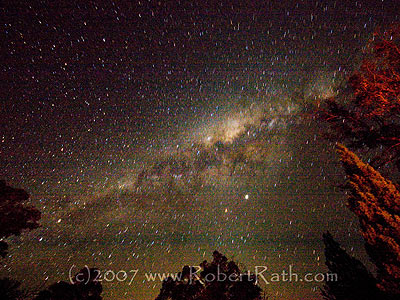 This weekend's get-away took us to the Flinders Ranges in South Australia's mid-north.
 How lovely it was to sit by an open camp fire, stare into the heavens and not have to worry about getting into a cold, damp wetsuit.
In all of the beauty this place has to offer, there is nothing like the feelings invoked by a starry night in the outback.
I hope this image gives a sense of the sky we never get to see in our suburban world.
Until the next post, take care out there and keep staring into the heavens ( if that's what you do! ) ...Robert
Photo: Robert Rath EOS40D 160s at f/8 ISO1600 10mm
Sunday, September 23. 2007
Just Another Day In Paradise - Edithburgh Jetty, SA
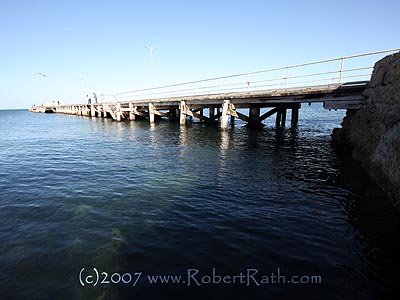 I just love this sleepy little town with its world-famous jetty. Many times though, I find myself teaching a group of new divers when that magic photo opportunity literally swims on by...
It was near the end of their fourth open water dive. I was leading the way back under the jetty while Alexius took care of the rear. In the distance, just out of vision there appeared a very large shadow which was not in a place I expected one to be. I realised it was moving and it was very, very large. A moment of fear, then a moment of excitement as the shadow turned back towards us.
Out of the gloom swam the most magnificent, majestic and certainly the largest stingray I have seen in nearly 18 years of diving. At around 2m in span and over 4m in length this Smooth Stingray, Dasyatis brevicaudata, glided through the pylons with both precision and grace. I turned and swam alongside for a few moments before leaving it to glide out into the sunlit water and disappear into the distance.
This was a magical experience that I may not have appreciated as much if I had been staring into the viewfinder of my camera. After the dive, it was wonderful to share the experience with my students, some of whom much to their chagrin had been looking elsewhere for the entire encounter.
Today was a wonderful reminder of why we go to all that effort to put ourselves under the waves: to bring back treasured memories like these.
Until the next post, take care out there and keep diving ( if that's what you do! ) ...Robert
Photo: Robert Rath EOS40D 1/250s at f/11 ISO400 10mm
Saturday, September 1. 2007
Once In A Red Moon, In Our Backyard
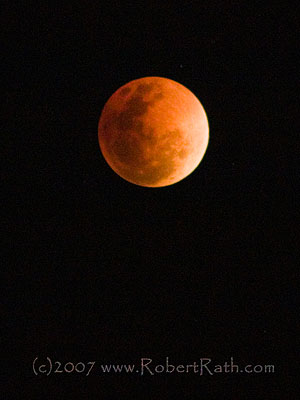 August 28, 2007 and we were treated to a most wonderful evening show. For around 45 minutes, the moon became red as it passed through the Earth's shadow.
This photograph was taken from my back lawn in competition with Adelaide's night sky.
Total lunar eclipses come in groups; usually we can observe two or three during a period of a year or so followed by a few years without any.
Lunar eclipses are visible from the entire night-time hemisphere of our planet. Because of this they are more frequently observed and seem to be numerous. They are, however, three to five times less frequent than their spectacular solar eclipse counterpart.
Until the next post, take care out there and keep staring into the heavens ( if that's what you do! ) ...Robert
Photo: Robert Rath EOS300D 1.6s at f/5.6 ISO1600 300mm
Saturday, August 18. 2007
Cod - Up Close And Personal, Cod Hole, GBR
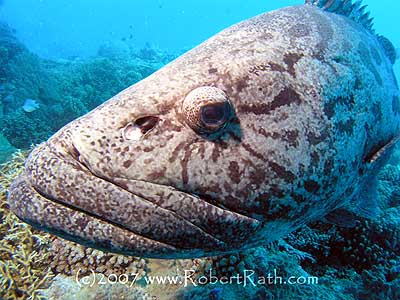 The Potato Cod, Epinephelus tukula, is one of the largest members of the groper family. Cod Hole, out on the Northern Great Barrier Reef, is renowned for its family of curious Potato Cod who make this a special location for all who visit.
This was our last dive of the trip and we were not disappointed. It was a beautiful, picture-perfect dive. Big cod, sharks, rays and the most amazing coral gardens. We lingered here for as long as we dared as the current became stronger and stronger. Finally we decided it was time to return to the boat.
As all divers are taught we had done the right thing and dived up-current during the dive. By the time we decided to end the dive the current was so strong we could no longer make any headway anyway.
The swim back to the boat took only a couple of minutes and as we neared I could tell we only had one shot. Racing in at 6m, we caught the first shot line on the port side of the boat. The current was so strong now it started dragging us to the surface. Still hanging on to the port shot line at 3m we grabbed the starboard line of the deco-bar and there Jennifer and I stayed locked together flapping wildly in the current. A minute later we had worked our way up to the starboard ladder and back on board. Hearts racing, adrenalin pumping - but smug at the fact that we did not have to be chased all over the ocean by the tenders like some of the other divers - we said our farewells to the Potato Cod of the Cod Hole!
Until the next post, take care out there and keep diving ( if that's what you do! ) ...Robert
Photo: Robert Rath C5060 1/30s at f/6.7 ISO200 Inon UWL100-28AD Lens and D2000 Strobe
Thursday, August 2. 2007
Lionfish, Pixie Pinnacle, GBR
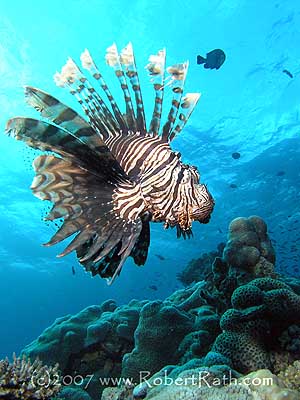 This Lionfish or Red Firefish, Pterois volitans, was a real poser circling the top of the Pinnacle. Yes, another cliché photo but one begging to be taken!
As mentioned in a previous post, Lionfish are common to the Indo-Pacific region and considered every bit a part of our tropical waters. Its new arrival in the U.S.A. however is not welcome at all since being introduced by the aquarium trade back in 1992. Having no natural predators in other parts of the world means this beautiful creature has become an introduced pest to our friends bordering the Atlantic Ocean.
Until the next post, take care out there and keep diving ( if that's what you do! ) ...Robert
Photo: Robert Rath C5060 1/125s at f/5.6 ISO200 Inon UWL100-28AD Lens and D2000 Strobe
Sunday, July 22. 2007
Nudibranch, Pixie Pinnacle, GBR
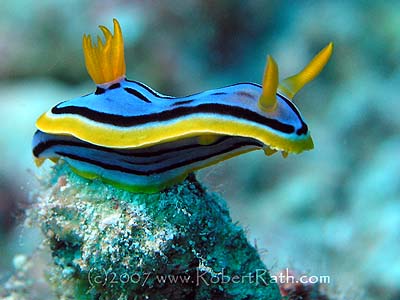 This beautiful nudibranch, Chromodoris elisabethina, or possibly , Chromodoris annae, was one of several different species we found at Pixie Pinnacle during our Minke trip.
The distinctive broken black stripe down the back is usually associated with ... elisabethina. See my previous entry for Chromodoris annae which clearly has no black markings. Please let me know your thoughts on the identification.
Pixie Pinnacle is an amazing site near Ribbon Reef #10. The pinnacle itself presents an amazing array of life and will often be the most attractive part of the dive. It is worthwhile though exploring the scree and rubble at the pinnacle's first base where we found a diverse world of small critters including Nudibranchs and Mantis Shrimps.
This little guy was down in the scree and rubble at 20m and reminded me of PNG "Muck Diving".
Until the next post, take care out there and keep diving ( if that's what you do! ) ...Robert
Photo: Robert Rath C5060 1/90s at f/4.8 ISO200 Inon UCL165AD Macro Lens and D2000 Strobe
Monday, July 16. 2007
Minke Whale, Blue Lagoon - Ribbon Reefs GBR
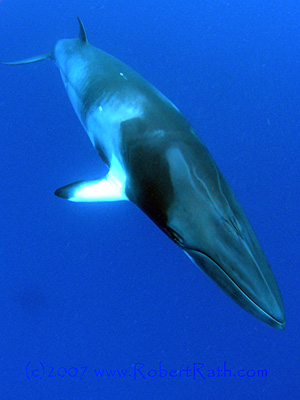 We have just returned from an absolutely wonderful trip to the Ribbon Reefs on the Great Barrier Reef. Three days of diving with Minke whales, reef fish, pelagics, sea turtles and even the odd diver have left us longing for the warm seas again now that we are back in Adelaide.
This one particular Minke swam straight towards me on several occasions, each time coming a little closer before bearing away. It was a magical experience, and at times I felt I almost wasted it being behind a camera!
Minke whales, Balaenoptera acutorostrata, visit the Ribbon Reefs every year during June and early July on their yearly migration. They are beautiful, inquisitive animals and actually seek out encounters with snorkellers and divers alike.
We dived from Mike Ball's Spoilsport and were impressed with their Minke education program as well as their adherence to a strict protocol used for Minke encounters.
For more information about Minke whales please visit http://www.minkewhaleproject.org/
Until the next post, take care out there and keep diving ( if that's what you do! ) ...Robert
Photo: Robert Rath C5060 1/90s at f/4.0 ISO200 Lens UWL100-28AD
Monday, July 9. 2007
Southern Dumpling Squid, Edithburgh Jetty Night Dive
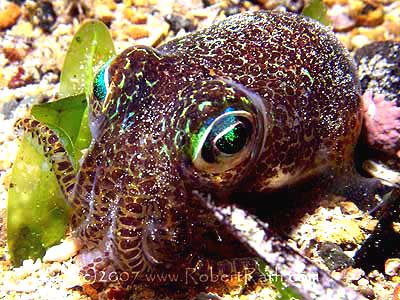 I can't believe it has been nearly a month since my last post! This last weekend we were in Edithburgh again with a group of nine Open Water students. Even with 11 degrees, wetsuits and less than 2m visibility, they were a fantastic and enthusiastic group. Well done!
Despite the teaching, the cold and poor visibility, we still managed a few "fun" dives and captured some lovely images. The photo for this post is a very awesomely cute Southern Dumpling Squid, Euprymna tasmanicas.
The amazing thing about the Southern Dumpling squid is that it produces light from an organ in its gill cavity. This organ contains bacteria that glow in the dark, and the dumpling squid uses this light to hide its silhouette from below by exactly matching the light from above. Very impressive camouflage technology!
On Sunday afternoon, my old mate David Bryant from Seapics http://www.seapics.com.au/ joined us for a dusk dive after having driven non-stop from Melbourne that morning.
David and some of his friends have come over to dive with the Whyalla cuttlefish, so it was a great chance to catch up and dive together again after some 12 or more years.
Until the next post, take care out there, keep diving ( if that's what you do! ) ...Robert
Photo: Robert Rath C5060 1/45s at f/8 ISO200 Lens UCL165AD Macro, Inon D2000 Strobe
Saturday, June 9. 2007
Short-Head Seahorse, Edithburgh Jetty Night Dive
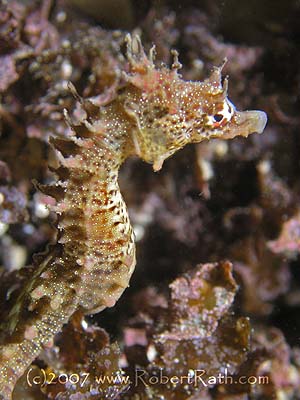 Night dives under Edithburgh jetty mean seahorses. Lots and lots of them! Almost all of them will be the Short-Head Seahorse, Hippocampus breviceps. No matter how patient I was, this little one would not look at me, so this is the best of a batch where turning away means 'you can't see me'.
Two wonderful days of diving here have left me with quite a collection of new photos, so stay tuned for more.
Until the next post, take care out there and keep diving ( if that's what you do! ) ...Robert
Photo: Robert Rath C5060 1/90s at f/4.8 ISO100 Lens UWL100-28AD, Inon D2000 Strobe
Sunday, June 3. 2007
Edithburgh Again, Shrimps In The Dark
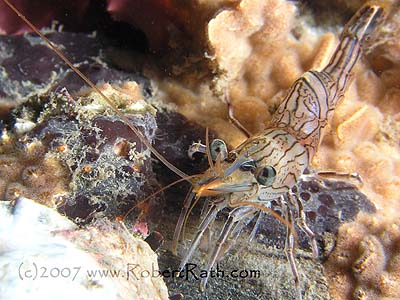 This little guy from tonight's night dive was a real treat to play with. I believe it is Rhynchocinetes australis but it could also be Rhynchocinetes kuiteri, so please drop me a note if you know for sure. For other underwater adventurers, calling it a shrimp will do nicely.
 The water is getting colder, but that simply means fewer people in the water and less silt in front of the lens. As much as I love taking people diving, there is nothing like having a little bit of space when wielding a camera.
A night dive is always a great way to prove to all the 'sensible' onlookers that the world is full of people doing crazy things. So, who'd actually want to be an onlooker on a beautiful calm moonlit Edithburgh night? Yes I agree too, the world is full of people doing crazy things!
Until the next post, take care out there, keep diving ( if that's what you do! ) ...Robert
Photo: Robert Rath C5060 1/60s at f/8 ISO100 Lens UWL100-28AD, Inon D2000 Strobe
Subscribe To My Posts
My Networking Sites

Twitter Updates
Calendar

|
October '26 |

|
||||
| Mon | Tue | Wed | Thu | Fri | Sat | Sun |
| 1 | 2 | 3 | 4 | |||
| 5 | 6 | 7 | 8 | 9 | 10 | 11 |
| 12 | 13 | 14 | 15 | 16 | 17 | 18 |
| 19 | 20 | 21 | 22 | 23 | 24 | 25 |
| 26 | 27 | 28 | 29 | 30 | 31 | |
Quicksearch
Categories
Syndicate This Blog

Blog Administration
random pics