Robertโ€™s Ramblings

a little on life, the universe and everything… …and maybe the odd bit of scuba diving too!

Finding the Beautiful Elusive Leafy Seadragon


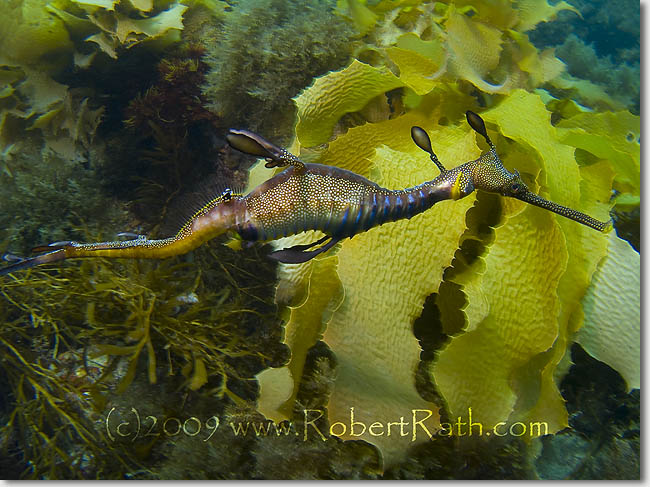
I dive with Leafy Seadragons often as part of being a tour guide for visitors to Adelaide who want to experience them for themselves. So far I count myself lucky that I’ve never disappointed anyone and have always been able to find them.

Following my last ‘Leafy’ dive, a group of us were discussing these creatures and how to find them. We all agreed that until you actually see your first Leafy, you have no idea what you are looking for. They are true masters of camouflage. All the photographs in the world do not prepare you for how they really look in their natural surroundings. As soon as you see your first one for real, it becomes somewhat easier.

When I was asked how do I find them, my first reply was that they are obvious. Of course this is not a very useful answer to anyone at all. I thought about it a little more and I came to realise that familiarity is everything. While I am diving, I look for those places where I know Leafys like to be. They like to be tucked in close to their surroundings, yet still free to move about quickly. They like to be in opportunistic locations, where plankton-like animals are likely to swim by in swarms. They don’t mind a little surge as long as the surge deosn’t separate them from their cover. They don’t like ledges or dark places because there is not much for them to eat. So I pretend I am a Leafy Seadragon, I look for a cosy little broad-leafed spot with plenty of passer-by morsels. More often than not I will find one already there!

This photo was taken at Victor Harbor last weekend and as usual, stunning and beautiful.

Jennifer has written a short log about about the dive at her ‘Dive Blog’ so please visit her site and leave a note at http://scubacailin.blogspot.com/2009/02/dive-133-lovin-local-leafies.html

Until the next post, take care out there and keep diving ( if that’s what you do! ) …Robert ๐Ÿ™‚

Photo: Robert Rath C7070 1/90s at f/4.8 ISO100, Inon UCL165AD Macro Lens, Inon D2000 Strobe + Natural Light
Smooth Stingray, Edithburgh


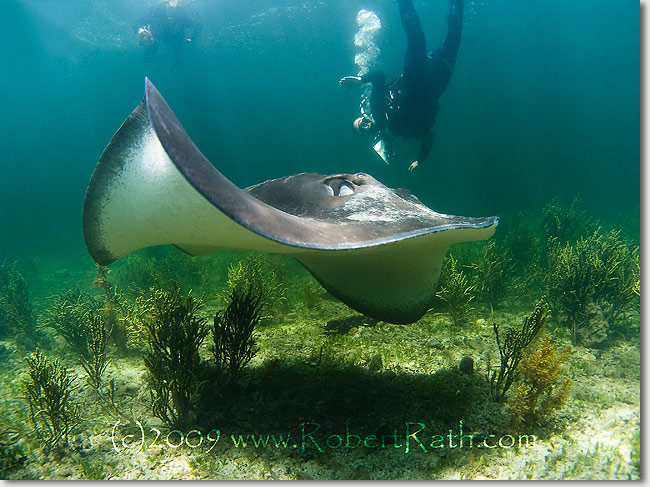
The Smooth Stingray, Dasyatis brevicaudata, grows up to 2m across and 4.3m in length making it the largest of all Australian stingrays. This fellow who we dubbed ‘Mr Ray’ was at least 1.5m across and was the highlight of our first dive in Edithburgh last Saturday. Mr Ray was quite curious about us and buzzed us a few times during the dive usually by sneaking up from behind and scaring the daylights out of us!

This first dive set the scene for a great underwater photography course with Mark, Bel, Peter, Jennifer and myself. With the recent hot weather we have been having here in South Australia the water temperature is way up. 25 degC made for almost tropical diving and all of us lamented our limited air and camera battery life. We all could have stayed underwater the entire weekend!

Until the next post, take care out there and keep diving ( if that’s what you do! ) …Robert ๐Ÿ™‚

Photo: Robert Rath C7070 1/90s at f/2.8 ISO80 Inon UWL100-28AD Lens, Natural Light

Black Is The New Black


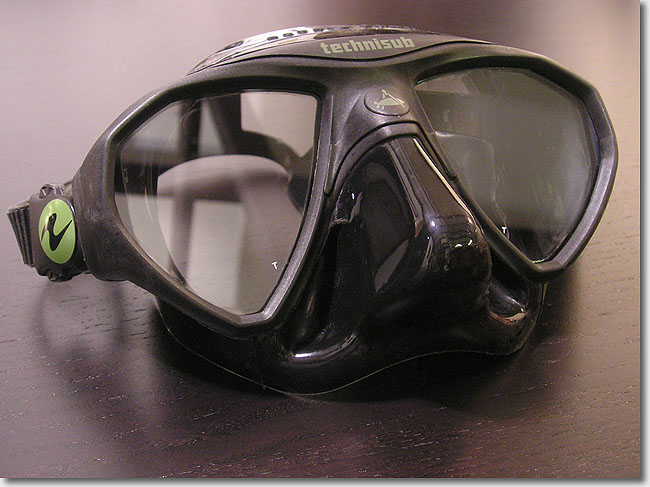
I’d been shown this mask some time back now and last Friday I borrowed one for a dive. I loved it so much I bought my own the very same day.

I have been hearing the pros and cons of black masks for years. I have always loved the extreme peripherial vision that comes with a mask with a clear silicon skirt, in spite of the lack of clarity through the skirt. The need to be aware of other divers on the extreme periphery has always been the priority for me as a dive instructor.

Enter Aqualung’s Micromask…

This mask is simply amazing in how it sits so close to your face and how little volume it has. I can nearly touch the glass with my eye lashes. Doing a mask clear requires little more than a puff of air. With this mask sitting so close to my face, the peripheral vision is excellent. Maybe it is not quite as good for that extreme peripheral awareness, but the peripheral vision you do have is through glass – and uncompromised.

Black Is Best … or My Unbiased Product Review ( honest I paid full price for mine! )

So why are black masks popular? Well, the disadvantage of having any source of light coming from behind the mask lens is that of internal reflection and glare. This light can come in through a clear mask skirt or through side lenses. At best, it will reduce the perceived contrast of your primary vision. At worst, it will be distracting and annoying.

The Cons

I think I only found two points about this mask which could be improved. The first is the design of the buckle. Even though it does its job very well, it does have multiple plastic parts, which increases its potential for failure. In comparison, a mask like the Mares X-Vision binds to the skirt giving the same flexibility with no breakable parts. My second point of issue, although minor, is the extreme shininess of the black silicon on the inside of the mask. I found that this shininess can also lead to reflections and glare, so I will be getting stuck into it with some fine grade wet-rub until it is nice and matt.

Summary

In 18 years of diving, the Technisub Micromask is my first ever black mask. It solves my old complaint of poor peripheral vision, prevents the glare from side and back lighting, clears with the slightest puff of air and most importantly it fits my face like a glove. I am very happy with my new mask and have to agree that black really is the new black!

As an aside, trying to take a good photograph of a shiny black silicon mask was much more difficult than some of the marine life I photograph! Try it yourself! ๐Ÿ˜‰

Until the next post, take care out there and keep diving ( if that’s what you do! ) …Robert ๐Ÿ™‚

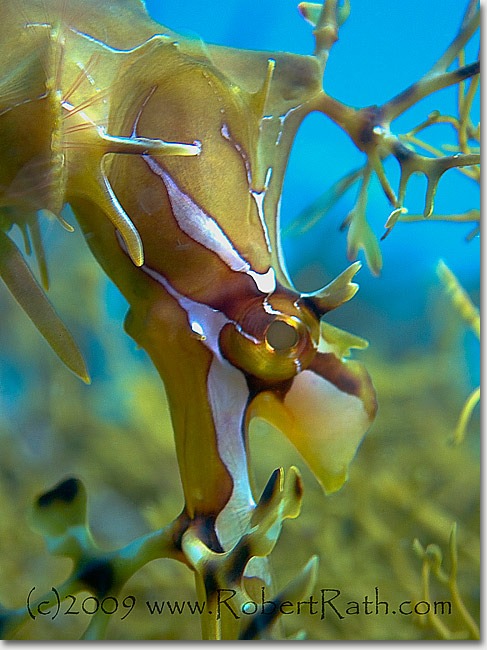
Weedy Seadragon, Victor Harbor


The Weedy Seadragon, Phyllopteryx taeniolatus is endemic to South Australian temperate waters. Like its close relative, the Leafy Seadragon, you will not find it anywhere else in the world.

Seadragons are closely related to seahorses but, unlike seahorses, they do not have an egg pouch for brooding. Instead, the males brood their young by attaching the eggs to their tail and looking after them until they hatch. Meanwhile, mum has long gone! Actually she’s probably not far away, but will have nothing to do with raising children!

This was my first dive for the year and was an opportunity to take my Argentinian guest, Gustavo, on a mission to see and photograph Leafy Seadragons. In all we found seven ‘leafys’ so the Weedy was a delightful bonus. It sure is nice to be back in the water again.

Until the next post, take care out there and keep diving ( if that’s what you do! ) …Robert ๐Ÿ™‚

Photo: Robert Rath C7070WZ 1/30s at f/8 ISO80, Lens Inon UWL100-28AD Lens, Inon D2000 Strobe

Testing an iFrame Version of WetShutter


Ok, so the use of the iFrame tag is a way to place rich content into a blog post if supported. The question for me now is, can you all see the rich content?

As an experiment, here is a Flash demo of some of my photos using an iFrame. Please comment on what you end up seeing in your own browser.

Until the next post, take care out there and keep using iFrames ( if that’s what you do! ) …Robert ๐Ÿ™‚

Testing Google Maps – My Little part of the World


While looking at how to make the content of my blog posts richer I happened across the mechanism of embedding a GoogleMap right where I want to show you something.

So here it is, one of our favourite places to go for coffee, dinner, a swim or maybe catch an awesome Henley Beach sunset. My next challenge will be to work out how to do a low pass fly by!

Until the next post, take care out there and keep Googling ( if that’s what you do! ) …Robert ๐Ÿ™‚

Adobe Backscatter Removal Action and Tutorial By Daniel Brown


If your are starting to suffer RSI from removing backscatter from your images then you might like to look at this tutorial by Daniel Brown of http://www.downloadculture.com.

In his article Daniel provides an Adobe Action which largely automates the process. There is still some work required hence the need to watch the video tutorial at http://www.downloadculture.com/uw/bs2007.html

To do this yourself you will need a copy of Daniel’s Actions, http://www.downloadculture.com/uw/backscatter.zip or here adobeAction_backscatter.zip

I have spent a little time now with this tool and it is very effective for some kinds of images. It is especially useful for silhouettes where the backscatter is not mixed in with the detail. If there is a lot of detail where the backscatter exists then it’s back to the old tools such as the clone stamper or the healing brush … and the RSI!

Until the next post, take care out there and keep diving ( if that’s what you do! ) …Robert ๐Ÿ™‚

Baby Anemone Fish, Which One Is Nemo?


This photograph taken of a clutch of Anemone Fish eggs clearly shows a bunch of youngsters patiently awaiting their escape into the world. These eggs were attached to a smooth rock on top of which was large Anemone along with doting parents.

When I took this photo the detail was not evident. Later on it was obvious how much detail there was in the developing babies. I have included a detailed close-up of a small section which really emphasise this. Next time I come across a clutch of eggs like this I plan on taking macro images.


So where are Mum and Dad? Jennifer was fighting them off while I took this photograph! ๐Ÿ™‚

Until the next post, take care out there and keep diving ( if that’s what you do! ) …Robert ๐Ÿ™‚

Photo: Robert Rath C5060WZ 1/90s at f/8 ISO100, Inon D2000 Strobe

Beautiful Edithburgh, Where it All Began


The small coastal township of Edithburgh in South Australia hosts one of the world’s best jetty dives. It comes as no surprise to me that it is here I did my very first dive as a newly certified open water diver on the 23rd of February 1990 and to this day it remains my favourite dive.

I have lost count of how many dives I have done here now but still it never gets boring. On almost every dive (where I am not teaching) I see something new, take better photographs than the time before or just experience being in this very special place as an absolute privilege. When I am teaching I am reminded of the thrill and exhilaration of experiencing this world for the first time.

This photograph of a Black Cowrie on one of the jetty pylons is typical of the beauty here. Ascidians, sponges and algaes abound covering every available surface. The fact that this image was taken earlier this year is testimony to the respect and care divers afford this site. As for describing the other marine life to be found here, I’ll just say come and see for yourself. You won’t be disappointed and you will be back for sure, many times over!

Until the next post, take care out there and keep diving ( if that’s what you do! ) …Robert ๐Ÿ™‚

Photo: Robert Rath C5060 1/15s at f/2.8 ISO200 Inon UWL100-28AD Lens, Natural Light