Robert’s Ramblings

a little on life, the universe and everything… …and maybe the odd bit of scuba diving too!

Street Graffiti

Not far from where we live a transformation is taking place as anonymous street graffiti artists bring colour to what had been a bleak industrial landscape.


          Scary Plant

Not sure if I’d be game to open that door. Maybe it’s a warning?


          Parking

Signage becomes art becomes signage. I parked in front


          Perspective

I love the way the lines of the brickwork intersect with strong vertical images.


          Purples

What’s worse than having ‘The Blues’? I think it might be ‘The Purples’!


          Purple & White

It seems that the aftermath of a good time leaves behind ’empties’. In this case, lots of them!

Until the next post, keep enjoying your local anonymous artists (unless it’s your house! ) …Robert 🙂

All Photos: Robert Rath, November 2011. Please ask if you want to know more about my images.


Spring Flowers


          Beautiful Pink Roses

Last week we spent the afternoon in my parents garden and took the time to admire the colours of Spring.


          Bird of Paradise

Complete with resident ants!


          Orange Blossom

The orange tree has not blossomed for years. The recent rain as done wonders.


          Purple Iris

The garden was full of Irises of all colours. The purple ones were my favourite.


          Purple & White

Note sure what these are but interesting to see both white and purple blooms on the same flower.


          More Colour

Another flower I could not put a name to but was most accommodating for the camera, waiting patiently for me to take this image.


          Catherine Wheel

OK, now I am just making up names but at least this one reminded me of Catherine wheels back in the days when we were allowed fireworks. I don’t remember any purple Catherine wheels back then!


          Sunny

Until the next post, keep enjoying the blooms of Spring (unless you suffer from hay fever! ) …Robert 🙂

All Photos: Robert Rath, October 2011. Please ask if you want to know more about my images.


Sydney In July


          Sydney Harbour Bridge

Last Saturday we headed over to Sydney for a little fun, catch up with friends and even a bit of work. Of course the camera tagged along!


          Syndey Opera House

Familiar Opera House sails in the distance with the Ken Done gallery in the foreground.


          Ken Done Gallery

Beautiful glass art in the Ken Done galley. Note the ‘no photographs’ sign to the right. I took this image from the street through an open door so I reckon the sign does not apply!


          The Rocks Market

Ghostly images mark the passage of many through ‘The Rocks’ market.


          Circular Quay

A beautiful sunny day at Circular Quay. ( I am told it was miserable in Adelaide! )


          Jennifer

The piano bar at ‘The Menzies’ with featured pianist tinkling the ivories!


          Skyward

Lying on the ground staring into the heavens and the stars Sydney style.


          Syndey Opera House

Until the next post, take care out there and keep traveling ( if that’s what you do! ) …Robert 🙂

All Photos: Robert Rath, Sydney, July 2011. Please ask if you want to know more about my images.


Diving Edithburgh Jetty At Night


          Four beautiful little short-headed seahorses, Hippocampus breviceps, on yellow algae.

On Saturday we headed over to Edithburgh for a lazy diving getaway. No students, no teaching, no courses, no pressure and no expectations. Just Jennifer, myself and my camera gear. We also planned to meet up with fellow ‘fish paparazzi’ friend Fred but with no expectations on when we would actually get in the water. I had not used my camera underwater for a few months so the time spent in inspecting and preparing every seal and ‘o’-ring of my housing and equipment was both meditative and an important part of the day.


          Sand Flathead, Platycephalus bassensis, waiting for a passing morsel.

I dropped below the surface of the chilly lapping water just after 8:30pm. A stark contrast to the cosy surrounds and hearty meal at the Edithburgh Hotel just a short time earlier, this cold and dark underwater world beneath the jetty immediately comforted me with familiar sounds, sights and the animals I just love to watch, photograph and wonder about. As always Edithburgh Jetty was alive with the the critters of the night out hunting, being hunted, being photographed or just hanging around.


          Lightning volute, Ericusa fulgetrum, on the hunt for other molluscs.

In my hour underwater I saw volutes searching for prey, sand snails laying eggs and flatheads waiting camouflaged in the sand ready to gulp in a passing morsel. I found short-head seahorses snapping at passing plankton, helmet crabs scouring the the sandy rubble and baby sea-urchins feeding in the sea grass.


          Unusually unadorned decorator crab, Naxia tumida

One of the most important things you can do on a night dive whether you are taking photographs or not is to spend a little time just resting still. Hover if you can or drop gently to some insensitive bottom and just wait for 5-10 minutes. It is amazing how you become aware of animals around you which were always there but you simply would never notice at a cursory look. Also after a while, animals which you may have originally scared away come back and you get to see what your little spot in the ocean is really like.


          Being eyballed by a beautiful giant cuttlefish, Sepia apama.

When it was time to return to the surface I took one last look around just in case any new creatures had wandered into the sandy clearing below the jetty steps.


          Sea urchine, Amblypneustes pallidus, feeding in the sea grass.

I wanted to linger longer, to take more photographs and to just be part of the scene around me, but time, diminishing air and the cold soon won out as they always do.


Until the next post, take care out there and keep diving ( if that’s what you do! ) …Robert 🙂

All Photos: Robert Rath, Edithburgh, May 2011. Please ask if you want to know more about my images.


And The Spider Had The Fly For Dinner


Tonight I spotted a this curious pair on the breakfast bar when just moments before Jennifer was complaining about some pesky fly. Strangely enough the pesky fly just vanished she said!

My immediate reaction when ever I spot a spider in the house is to catch it and let is go but it soon became obvious that this guy was not going anywhere until he had finished his meal giving me ample time to take a few photos. He actually took a few hours but when he was done there was only a husk of the fly remaining and his abdomen had swollen to twice its original size.


Because I did not want to disturb him with the bright flash of a strobe I was limited to wide apertures, natural light and slow exposures. I like these conditions anyway as natural lighting is almost always, well, more natural 🙂


Until the next post, remember to catch and let go, catch and let go. Even spiders! …Robert 🙂


Photo: Robert Rath: And The Spider Had The Fly For Dinner


Weightless


Last night I spotted a photo competition on the Canon 1Wall website with the theme ‘weightless’. As a diver and avid photographer this caught my eye so I looked at some of the entries and started imagining some new photo ideas around this theme. That’s when I noticed the competition closed the next day so a change of tack saw me getting creative in the kitchen again in my quest to photograph ‘weightless’.

I experimented with quite a few ideas before this final image came together with nothing more than a glass of water and a drop of soy sauce. Unfortunately when I went to submit my entry the competition had closed. Oh well, next time I’ll go looking for an image I’ve already taken but at least I had fun and have a great image to show for my efforts.


Until the next post, get weightless and wet as often as you can! …Robert 🙂


Photo: Robert Rath: Weightless


Where Are All The Edithburgh Leafy Seadragons


Last month a few of us travelled to Edithburgh for an underwater photography course. The weather was clear, the water cold and the diving gentle and relaxing. As usual the life under and around the jetty was teaming and we all took some great photos even though the visibility was not stunning. It was here I saw my first leafy seadragon some twenty years earlier.

Edithburgh has never been a great place to find leafy seadragons. There are other places in South Australia more reliable but Edithburgh is such a wonderful place to dive that finding a leafy seadragon or two is such a wonderful bonus to an incredible site.

So where are the Edithburgh leafys? Well in twenty years I have only ever seen a dragon under the jetty three times and this is not surprising really as this is not their natural habitat without the heavy seaweed cover they normally inhabit. To find leafys at Edithburgh you need to leave the jetty and look for large groups of brown algae seaweed. I have found them in every direction from the jetty. To the south, the west and the north. Be prepared to swim a little and make sure you are using a good pair of fins, especially if there is a little current. When you find a large grouping of brown algae seaweed don’t just scan the area as you swim past. Leafy seadragons are easily missed due to their wonderful camouflage. Settle somewhere in the middle, be still , watch wait and study. Even if you do not fond a dragon you will notice things that you would never see just swimming by. My experience is that you don’t just look and see leafy seadragons. They come into view as you are staring at the seaweed. Almost like magic a dragon will appear exactly where you are staring even though you have stared at the same spot for a while. So be patient and then move on and good luck!

I took this photo of a young adult last month during our Edithburgh course. The little critter was not particularly co-operative preferring to stay hidden in the weed. I’m just happy to say you can still find leafy seadragons at Edithburgh.


Until the next post, take care out there and keep diving ( if that’s what you do! ) …Robert 🙂


Photo: Robert Rath, Leafy Seadragon, Edithburgh. Please ask if you want to know more about how this image was taken.


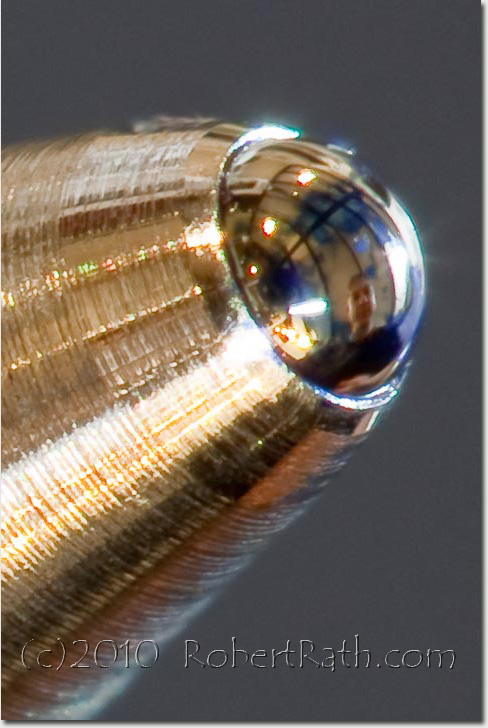
Macro Photography, Selft Portrait In A Ball Point Pen


Have a close look at this image and you will clearly see a reflection of myself in the shiny surface of the ‘thing’ I have photographed but what are you looking at a photograph of? Believe it or not, that reflection is coming from the ball of an ordinary ball point pen. Welcome to the world of macro photography!

I love the way macro brings a world to life around us that we are normally oblivious to as we go about our lives. Just a few minutes in the kitchen will reveal an infinite variety of amazing perspectives if we can get small enough to perceive them or make them large enough to have an impact. The second of these two strategies via macro photography is clearly the easier task unless you are in possession of a shrinking ray gun.

So how macro is macro?

The standard definition of a macro image comes from film camera days where an image 10mm high translated directly to an image 10mm high on a 35mm negative or slide. This 1:1 image ratio or smaller was deemed to be ‘macro’ while larger than this was simply ‘close-up’. Today we use the term a little more loosely as many camera manufacturers proclaim their cameras are macro capable but very few achieve true 1:1 macro. This is further complicated as image sensors in nearly all cameras (with a few exceptions) have a much smaller image sensor than the original 35mm slide or negative.

So what are your options if you want to bring the very small into focus (pun intended :-)?

A. Purchase a compact digital camera with a very good macro mode.

Many compact cameras are able to focus very close to a subject when placed in ‘macro’ mode. Even if true 1:1 macro is not possible the results in good light can be excellent. The key with these cameras is their ability to get very close to the object they are taking a photograph of. This is fine when there is lots of natural light but often this is not the case. Often the image is so close to the lens of the camera that light from the flash will be shadowed by the lens and it will not be possible to sufficiently light the subject. Some cameras, notably the Olympus 5060 and 7070, disable the flash in macro mode for this very reason. In most cases however good results can be obtained by using the camera with a tripod and timer and allowing the camera to do a long time exposure in order to get sufficient light.

B. Purchase a DSLR camera with a dedicated macro lens.

This is the best solution if you can afford the hardware and don’t mind managing the bulk of large cameras and lenses. Dedicated macro lenses combine the qualities of a telephoto lens with close focus. This provides good magnification of 1:1 or better without having to get too close to the subject. Lots of light is available from in built flash or external strobes and taking good macro images in the realm of 1:2 through to 5:1 is relatively easy depending on the lens. It is worth noting that auto-focus becomes more challenging for the camera at macro ratios greater than 1:1. Lenses designed for macro ratios greater then 1:1 will almost always need to be manually focused even if they are auto focus capable.

C. Use extension rings or diopters with a standard lens and a DSLR camera.

The use of extension rings or diopters creates apparent magnification by allowing a standard lens to focus more closely and hence achieve greater magnification. This is a commonly used by those who already own a DSLR camera and want to dabble in macro imaging. The issues with macro rings are very similar to those experienced by compact camera users, namely the close proximity of the object to the lens and difficulty in both lighting the subject and also in achieving acceptable depth of field. In some cases compact cameras will do better due to their smaller image sensor and associated better depth of field. An image sensor in a compact camera which is only 25% the size of that in a DSLR camera can take the same image at 1:2 image-to-sensor ratio while the DSLR struggles at 1:1.

Depth-of-field Issues

Any time a lens is placed close to a subject it requires a smaller and smaller aperture to achieve acceptable depth of field. For large apertures it is not uncommon to be struggling with a focal plan less than 1mm in depth where anything outside of this 1mm good zone becomes progressively unfocussed. Stopping down the lens to f8, f16 or even f32 widens the depth but at a huge cost to available light and the absolute dependence on strong strobe lighting or very long time exposures. The higher in magnification you go these problems become exponentially worse to the point that 10:1 is really the limit without going to dedicated microscope hardware.

To wrap up I would suggest making a start into the world of macro photography with a good digital compact, a sturdy tripod and an equally good deal of patience. The results from compact cameras can be quite stunning and now with the higher megapixel counts available you have a lot of scope for cropping to achieve even greater apparent magnification. If you already have a DSLR camera I would really suggest aiming to purchase a dedicated macro lens. Extension tubes with standard lenses will always present frustrating problems with low light and poor depth of field although good results can still be achieved with patience.


Until the next post, drink the potion or nibble the cake and see where the rabbit hole leads! …Robert 🙂


Photo: Robert Rath: Self Portrait In A Ball Point Pen